

Back
Share
May 25, 2026
22 minutes
Posted in:

A fully automatic coffee machine is a strategic asset for any HoReCa activity: it affects the quality of service, customer satisfaction, and the overall efficiency of your business. Its ability to maintain its value over time and guarantee high performance depends, however, on a variety of factors: from the choice of the model best suited to real operational needs and of the right partner for technical support, through to definition of a clear, organised, well-planned maintenance strategy.

1. Performance and reliability: the value of coffee machine maintenance for businesses in the HoReCa sector

When you invest in a professional coffee machine for your business, you must always consider the lifespan it can guarantee. Effective lifespan however depends on many factors such as the context, the volume of drinks served every day, management of peak service times,the quality of the coffee and the water, and, last but not least, also how often the machine is cleaned and how much attention is paid to general maintenance.

The choice of model also affects the machine’s ability to perform well over time. Egro clearly explains the ideal daily production capacity, expressed in cups/day, of all its coffee machines. This factor is fundamental for making the right choice, in other words choosing the coffee machine with a production capacity suited to the context and business in question and, as a consequence, to the number of drinks served to customers. Prolonged use of a coffee machine unsuited to the volumes required by the business forces its internal components to work beyond the limits for which they were designed, significantly accelerating wear and tear.

If periodically and properly cleaned and maintained, an Egro fully automatic coffee machine may continue working excellently for longer than its expected ten-year lifespan. Any machine that is not properly maintained will, in any case, tend to deteriorate faster. And this mainly happens with the more delicate components that require special attention like the group head, grinders, boilers, and valves.

A coffee machine is therefore a primary asset for businesses in the HoReCa sector. In the same way as any other kind of professional equipment, it is an investment and as such it is important to preserve its value and full efficiency with constant accurate maintenance. Maintenance is the combination of all the actions throughout the lifespan of an appliance that are carried out to preserve or restore the asset to a state that enables it to carry out its required function. In other words, maintenance is what determines the continued efficiency of the coffee machine, its capacity to work properly over time, and the quality of the drinks served.

Maintenance is carried out to: prevent malfunctions, reduce downtime, lower repair costs, and, more in general, prolong the machine’s lifespan, preserving its value.

There are many different types of maintenance for fully automatic coffee machines that businesses can choose to safeguard their assets. They can choose from a range of different strategies for machine maintenance; the main ones being reactive, preventative, predictive, and reliability-centred. Businesses can also adopt a mixed approach, combining different maintenance strategies to guarantee the best results depending on the context, type of machine, and available budget and resources. Maintenance may be routine or non-routine and include: diagnosis, cleaning, lubrication and adjustment of internal parts, repairs, replacement of components, and even improvements to performance or function, such as, for example, installing a software update.

2. The tangible benefits of correct maintenance of professional coffee machines

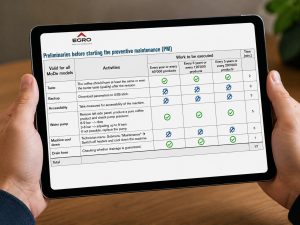
By registering on the Customer Support Portal, Egro service technicians gain access to all technical documentation in digital format
By registering on the Customer Support Portal, Egro service technicians gain access to all technical documentation in digital format.

To regard maintenance merely as a way of avoid malfunctions would be wrong as the actual aim of it is to preserve quality, reduce operating costs, and guarantee uninterrupted service. Maintenance of fully automatic coffee machines produces numerous benefits on both a technical and operational level.

The first and most immediate concerns the quality of the drinks served. A clean, calibrated machine with a precise maintenance plan, dispenses excellent drinks. Whereas, a coffee machine that is not regularly maintained as needed may cause problems that can alter the taste in the cup: odd-tasting coffee, drinks that are too hot or too cold, slow or irregular dispensing, residues, or an unpleasant aftertaste. These are not just simple problems, but important indications that the machine is not properly cared for and/or cleaned.

The second benefit concerns the lifespan of a professional coffee machine. Regular maintenance slows down natural wear and tear, preserves the internal parts, and prevents accelerated deterioration of the more delicate components that, over time, may lead to unexpected breakages, machine downtime, and/or expensive repairs.

From an economic point of view, regular maintenance means considerable savings. Prevention is always cheaper than having to manage malfunctions in an emergency situation and unplanned machine downtime. These cases always require a specialised technician, with higher repair costs and longer downtimes. Furthermore, a properly maintained coffee machine consumes less energy.

Finally, maintenance plays an essential role in guaranteeing safety and hygiene. The presence of milk, water, and organic residues may cause the proliferation of bacteria if not treated regularly. It is very important to always keep the machine clean and to check worn components that may become a source of contamination.
3. Troubleshooting Egro: how to recognise and solve the most common problems using reactive maintenance

Reactive maintenance, known also as run-to-failure maintenance, is the easiest as it simply means fixing your professional coffee machine only when it breaks. Another way of defining it could be all those measures needed to restore the machines original functioning, in other words to restore it to normal working order by replacing or repairing the broken component when a problem arises.

This kind of maintenance is effective mainly for machines that can be repaired easily and quickly at little expense. This is a feasible strategy when it is cheaper to wait for the machine to malfunction before intervening. Reactive maintenance is usually the preferred option for those businesses that would not see benefits justifying the greater initial investment required by other more complex forms of maintenance, such as preventive.

Generally speaking, evolved maintenance strategies, such as preventive and planned, are always preferable to corrective maintenance. However, there is nearly always a middle option that guarantees better results and more efficient costs, namely a mixed strategy that combines a balance of preventive and corrective maintenance.

While maintenance is all the actions carried out to maintain the efficiency and perfect working order of a machine, troubleshooting is the specific resolution of a technical problem when something isn’t working properly. This process identifies, diagnoses and resolves problems or malfunctions inside the coffee machine. Unlike preventive maintenance, which aims to prevent malfunctions before they happen, troubleshooting intervenes after a problem arises to restore the machine to normal working order. Troubleshooting is divided into four quite separate phases: identification of the problem, diagnosis to isolate the cause, resolution thanks to repair or replacement of the faulty component and checking of correct working of the machine to ensure that the problem has been resolved effectively.

Egro provides complete troubleshooting manuals that allow the nature of the problem to be quickly identified and an adequate solution to be found. Many of the most common problems derive from easily resolvable factors. When the coffee is watery, for example, it is often necessary to check coffee grinder calibration or if the correct blend is being used. If, on the other hand, the machine is dispensing lukewarm coffee, the problem might be limescale in the boiler or less than optimum extraction parameter setting. Other problems might depend on an incorrect milk temperature, the pipe not being fully immersed or a blocked nozzle.

Egro guides, which also contain instructions from the technical manuals, allow technicians and operators to accurately identify the cause of the problem and, when possible, offer instructions on how to intervene rapidly and effectively.

4. Reactive vs. preventive maintenance: which strategy really protects your coffee machine?

The main difference between reactive and preventive maintenance lies in its timing, in other words when it is carried out.

Reactive maintenance only happens after a fault has occurred. It is a simple, immediate approach focused on restoring the coffee machine to working order. However, it has some big limitations: unexpected downtime can be lengthy and repair costs can rise rapidly. Furthermore, the total unpredictability of malfunctions makes it difficult to plan the field service team’s work, manage spare parts stock effectively, and ensure operational continuity.

Preventive maintenance follows a completely different approach. It does not wait for a fault to occur, but anticipates it through a series of periodic checks and scheduled replacements of parts subject to wear and tear. These measures, carried out regularly on the coffee machine at set intervals, are all managed by Egro service centres and follow the same principle as car services.

The main advantage of this strategy lies in the simplicity of planning and the reliability of preventing malfunctions caused by normal wear and tear without any of the high costs associated with advanced monitoring technologies. However, this strategy brings with it the risk of over-maintenance. Following a strict schedule of planned maintenance may cause still-functioning components to be replaced, leading to wasted resources, and making it difficult to identify faults that occur between scheduled maintenance intervals.

Although it requires a bigger initial investment, preventive maintenance is, on the whole, more sustainable for any coffee business. It drastically reduces costs associated with sudden malfunctions, ensures consistent performance, and means the coffee machine will work for longer under optimal conditions.

5. Preventive maintenance according to Egro: planned maintenance and notifications for operators

The preventive maintenance plan for Egro coffee machines is a document detailing what preventive maintenance measures should be carried out, when, and how. It is the fundamental document at the base of the entire Egro preventive strategy and the result of collection and analysis of data gathered in the field over the years, as well as the quality control and testing work carried out on all Egro coffee machines leaving the factory.

The maintenance plan serves as an operational guide for the day-to-day activities in all Egro service centres worldwide and acts as a strategic checking tool. It enables the tracking of all activities carried out, the identification of trends and anomalies, and the improvement of both processes and products. Every Egro fully automatic machine comes with relative technical manuals that detail the checks to be carried out, recommended frequency, and how to assess the condition of components. The operating instructions show how to clean and lubricate components subject to wear.

Preventive maintenance plans developed by Egro are based on analysis of data collected by technicians and on KPI monitoring to assess the effectiveness of the implemented plans. All this information also serves as the primary source for the continuous updating of all Egro documentation, from technical manuals to troubleshooting guides, and for training the LVM models underpinning the Egro Customer Support App.

During a scheduled service call, the authorised Egro technician carries out a series of thorough checks. This begins with inspecting the condition of wear-prone components, such as seals and valves. The milk circuits, boilers, heating quality, and temperature settings are then checked. The technician also checks for any updates requiring installation, making sure that the most recent version of the software is always installed.

Every machine shows early warning signs when a component begins to wear out. Without regular maintenance, these signs go unnoticed until they develop into more serious problems, often entailing high repair costs. Whereas a periodic check-up ensures the machine remains in optimal condition.

In addition to its service schedule, Egro incorporates an advanced system into all its fully automatic coffee machines that notifies the operator when maintenance is required.

These alerts are therefore an integral part of the planned maintenance process: an intelligent system designed to simplify operators’ work and facilitate the work of technical support, and they must not be ignored. Each alert is generated by objective criteria, such as the number of cups dispensed or the time elapsed since the last service. In the event of more complex issues, they may suggest contacting Egro technical support.

Responding to alerts and reacting promptly, taking action independently where possible is the only way to protect your machine and, above all, the investment you made when you purchased it.

Via the Customer Support Portal, authorised technicians can consult up-to-date documentation online, find codes and descriptions for service kits, download manuals and software updates, and browse playlists of video tutorials.

6. How to protect your coffee machine from limescale with planned maintenance

Limescale is one of the main threats to the health of coffee machines. Although invisible, it slowly builds up on internal components, affecting how they work. Limescale deposits reduce boiler capacity and damage circuits and valves, forcing the machine to work harder and harder, which can lead to serious problems in the long term.

Preventing limescale building up depends on proper management of mains water. The use of professional filter systems is the first step in preventing harmful deposits: certified filters reduce the mineral content of the water, maintain stable TDS levels, and improve the flavour of the coffee. However, the filter cartridges must be replaced regularly, as a saturated filter no longer retains minerals and becomes ineffective.

Monitoring water hardness is equally important. Each geographical area has its own particular characteristics, and adapting your filter system to the local water hardness level offers you a choice of the most suitable solution and keeps the machine in optimal condition. Egro recommends installing a water filter system for all its coffee machines. This is therefore an important aspect to consider when installing a machine. Equally important is the maintenance plan for the filter system. Following the manufacturers’ instructions and scheduling regular maintenance for the replacement of filter cartridges (or the regeneration of resins in cation‑exchange water softeners) are key aspects of any maintenance plan. Proper water management ensures a longer lifespan for your coffee machine and improves the quality of the drinks served.

7. From preventive maintenance to predictive maintenance

The choice between preventive and predictive maintenance depends mainly on the level of technology available and your budget. Predictive maintenance, however, is generally more cost-effective, as it intervenes only when truly necessary.

As we have already seen, preventive maintenance is based on set intervals and generic parameters defined in advance for each coffee machine. Whereas, by utilising IoT technologies, predictive maintenance relies on continuous analysis of the data generated by the coffee machine to predict the exact moment when intervention is required.

This is therefore a more advanced maintenance strategy, which, however, requires companies in the coffee industry to make a more substantial initial investment in technology to equip themselves with a telemetry service and more advanced analytical capabilities.

Interventions are scheduled only when certain metrics reach set critical thresholds. This approach also significantly reduces the risk of over-maintenance, as interventions are justified by real data and there is no possibility of scheduling unnecessary on-site interventions or replacing components that are still functioning, as instead happens when opting for a preventive maintenance strategy.

Egro has developed a highly organised approach to predictive maintenance with its Kitchen Connect telemetry system, now available for Egro Next and Egro MoDe. Thanks to Kitchen Connect, all telemetry data generated by a single Egro coffee machine, or an entire fleet of machines, is collected and then made available for real-time monitoring and analysis via customisable dashboards.

Predictive maintenance is part of a service structured not only to protect your coffee machine, but also to constantly improve the quality of the entire after-sales service offered to Egro customers worldwide.

8. The Egro Training Centre: where specialist technicians are trained

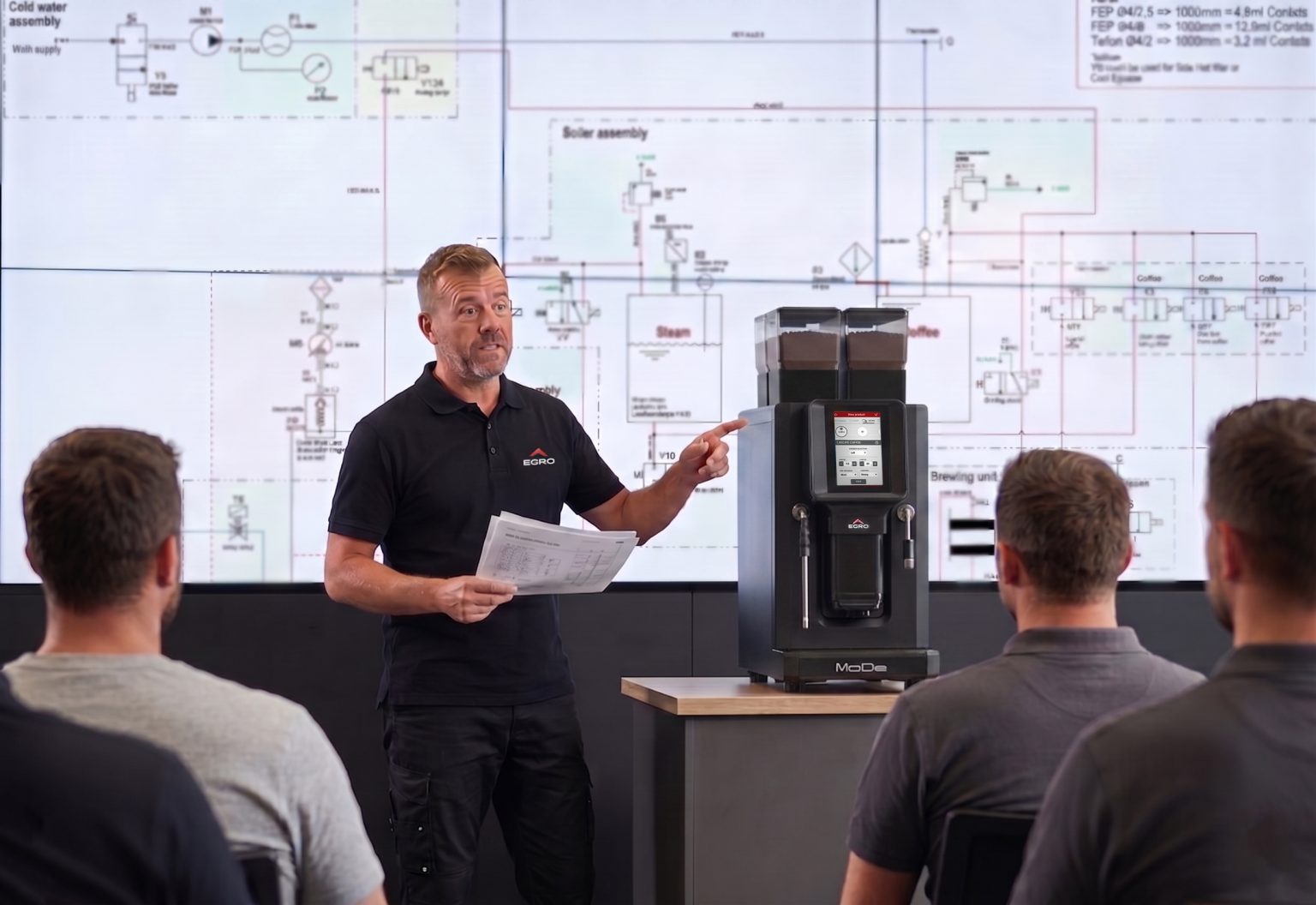
The technical courses held at the Egro Training Centre are also available as webinars.

The Egro Training Centre is a strategic player in the entire after-sales support ecosystem. It is a facility designed to offer training courses with the focus on professional fully automatic coffee machines, the aim being to impart solid, up-to-date technical skills that can be immediately applied in the field. The entire training programme stems from the understanding that quality of service depends largely on the technicians’ expertise: A well-trained professional can diagnose problems faster, intervene with precision, and ensure the machine has a long working life.

At the Training Centre, technicians can explore both the theoretical and practical aspects of maintaining and managing Egro coffee machines. The sessions alternate study and practical exercises, with participants working directly on the machines, simulating real-world usage scenarios and learning to manage every stage of service, from installation to component replacement, cleaning cycles, and routine and non-routine maintenance procedures. This hands-on approach allows technicians to get familiar with Egro products and obtain professional training certificates, a fundamental requirement for all authorised Egro technicians.

The training programme is flexible and designed to meet the diverse needs of Egro’s partner companies and customers. Courses are either in-person or online via interactive webinars, and each company can create a bespoke programme tailored to participants’ technical levels and the coffee machine models they manage.

One of the key benefits for authorised service centres is continuous access to technical information. Whenever a software update, a new retrofit kit, or an improved procedure is released, technicians receive email and app notifications. The Customer Support Portal also gives them access to installation manuals, technical documentation, wiring and plumbing diagrams, step-by-step procedures for activating warranties, and the e-commerce platform for purchasing original spare parts.

For the end customer, all this translates into a faster, more competent, and more reliable assistance. Every service call carried out in the field generates useful data that contributes to the continuous improvement of products and processes, creating a virtuous circle in which technician training, service efficiency, and machine quality evolve together.

9. Daily care and maintenance of coffee machines: the recipe for quality

Maintenance is not an occasional task, it is an essential daily action that ensures a long lifespan for every coffee machine. As we have seen, a truly effective strategy is based on different factors: regular cleaning cycles, prompt management of alerts, planned servicing, a well-defined maintenance plan, and a professional water treatment system.

When these factors are managed carefully and precisely, the machine not only operates more reliably, but also ensures superior-quality drinks. A well-maintained machine is an asset that works for the business with no interruptions.

Egro solutions are specifically designed to make maintenance an easy-to-manage process, planned in detail, and perfectly integrated into your daily routine. Looking after your coffee machine ultimately means looking after your business and offering a better experience for both operator and end customer.

Find the right coffee machine for your business

Need help choosing? Answer some questions and find the right coffee machine for your business
Go to Coffee machine finder